geointerpo
Point data in. Smooth interpolated raster out.
18 methods · live weather & air-quality APIs · uncertainty quantification · interactive maps.
Why geointerpo?
-
One API, 18 methods
Every algorithm shares
.fit()→.predict(). Swapmethod=to compare IDW, Kriging, Cokriging, SGS, GP, and 12 more without changing any other code. -
Smart boundaries
Pass a place name, a file, or a bbox. The pipeline geocodes it, derives the grid, and clips the output automatically.
-
Live data, zero setup
Pull real weather and air quality data from Meteostat, OpenAQ, Open-Meteo, and NASA POWER — no API keys needed. ERA5 reanalysis via CDS API.
-
Uncertainty quantification
Kriging variance surfaces, GP posterior std, RF bootstrap intervals, and conformal prediction (MAPIE) — every method can now express how sure it is.
-
Interactive maps
result.plot_interactive()renders a zoomable map with plotly or leafmap — no static PNG, no extra code. -
Auto-ranked cross-validation
Spatial k-fold or leave-one-out CV runs automatically.
result.best_method()andresult.rank_methods()tell you which algorithm won. -
Export anywhere
Save to GeoTIFF, NetCDF, or PNG. Every output carries CRS metadata and is ready for QGIS, ArcGIS, or further analysis.
-
50–200× faster IDW
KD-tree vectorized IDW replaces the old per-point loop — identical results, dramatically less waiting on large grids.
Quickstart
from geointerpo import Pipeline

result = Pipeline(
    data="stations.csv",
    boundary="Calgary, Alberta, Canada",
    method=["idw", "kriging", "spline"],
    resolution="5km",   # ← km strings now supported
).run()

result.plot()               # side-by-side matplotlib comparison
result.plot_interactive()   # zoomable plotly map
result.best_method()        # → "kriging"
result.rank_methods()       # ranked DataFrame
result.save("outputs/")     # GeoTIFF + PNG + metrics CSV
from geointerpo.interpolators import KrigingInterpolator, MLInterpolator

# Kriging: mean + variance surface
model = KrigingInterpolator().fit(gdf)
mean_da, var_da = model.predict_with_variance(bbox, resolution=0.1)

# RF: bootstrap prediction interval
model = MLInterpolator(method="rf").fit(gdf)
mean, lower, upper = model.predict_with_uncertainty(bbox, alpha=0.1)
# Cokriging with elevation as secondary variable
from geointerpo.interpolators import CokrigingInterpolator

model = CokrigingInterpolator(
    secondary_col="elevation",
    secondary_fn=dem_lookup_fn,   # callable(xs_utm, ys_utm) → elevations
).fit(gdf_with_elevation)
grid = model.predict(bbox, resolution=0.1)

# Sequential Gaussian Simulation — stochastic realizations
from geointerpo.interpolators import SGSInterpolator

model = SGSInterpolator(n_realizations=100).fit(gdf)
mean_da, std_da = model.predict_with_std(bbox)
all_realizations = model.realize(bbox)  # (100, n_lat, n_lon) DataArray
No data? No problem.
Use data="sample" for a built-in synthetic dataset — no network, no API keys, runs in seconds.
Methods at a glance
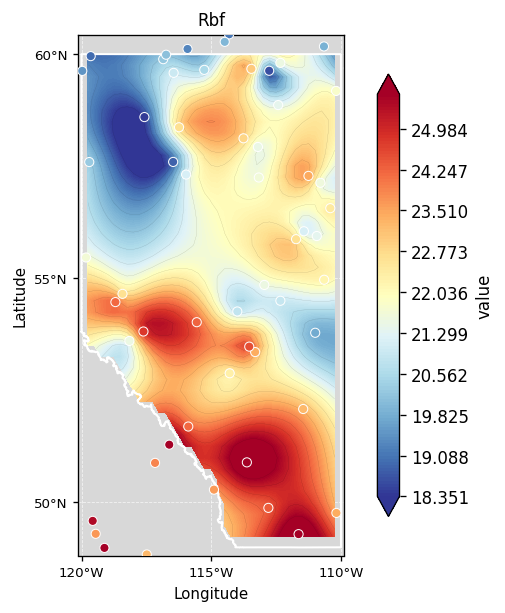
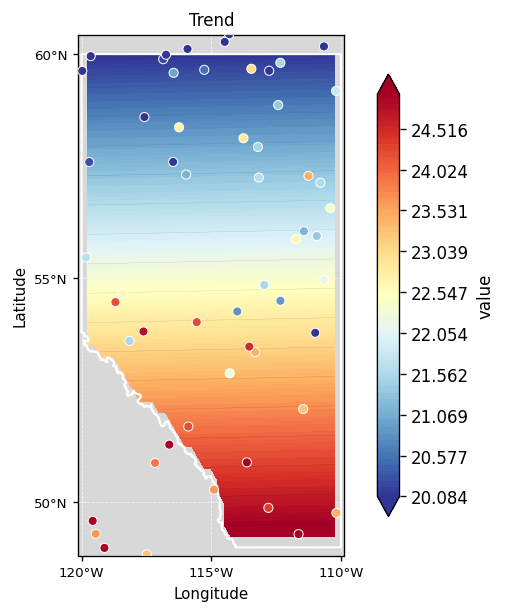
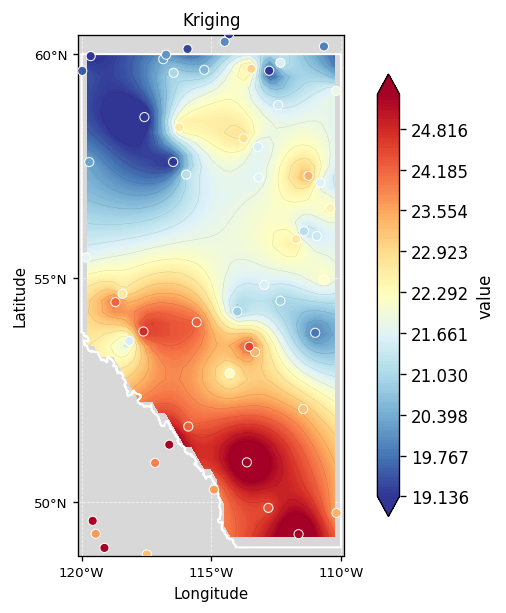
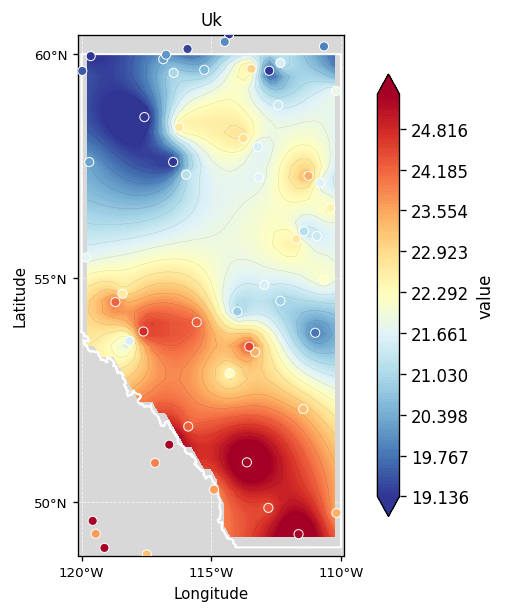
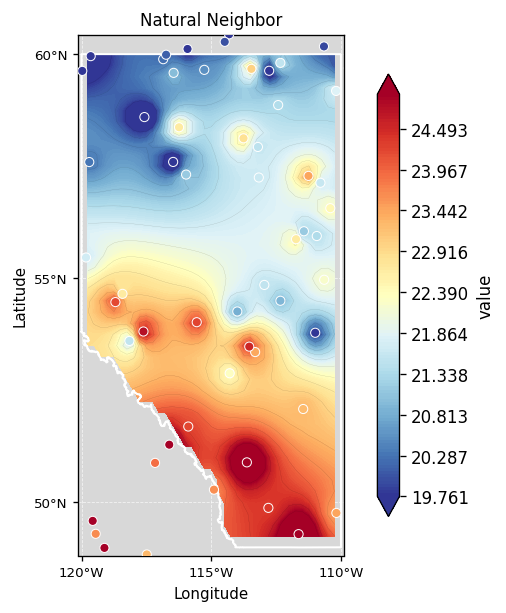
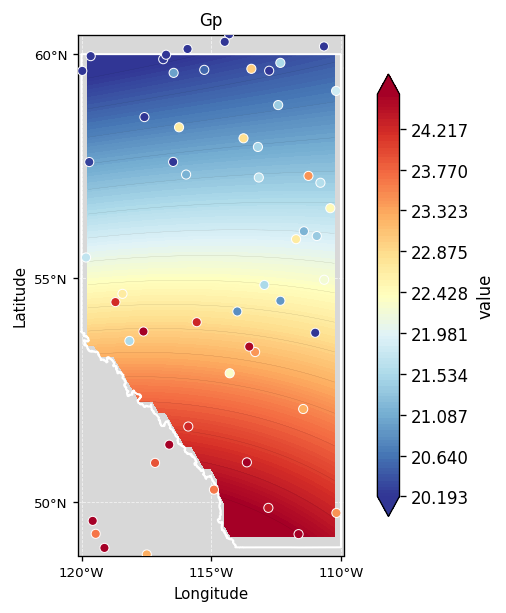
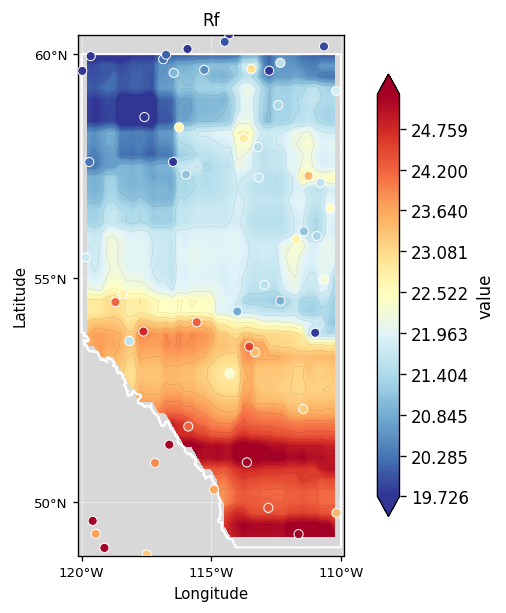
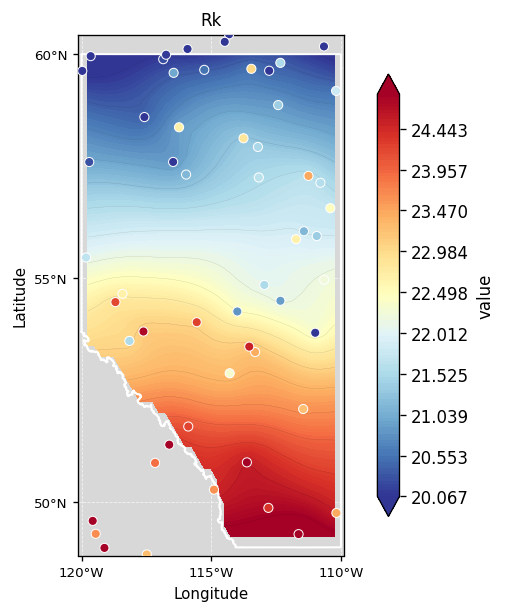
All outputs below use the same 60 weather stations over Alberta, Canada.
Distance-based
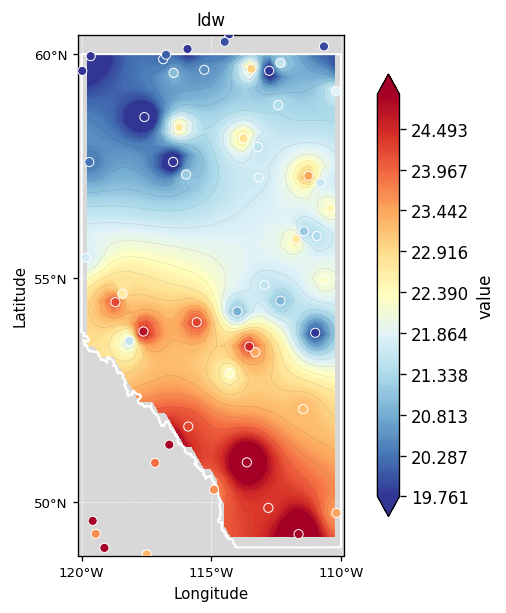
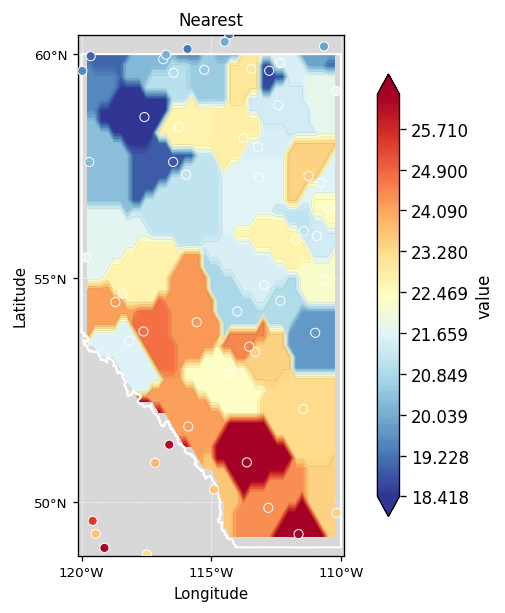
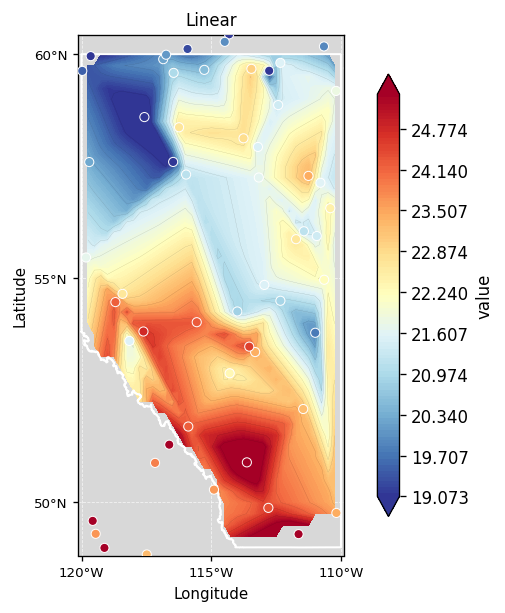
Spline & Trend
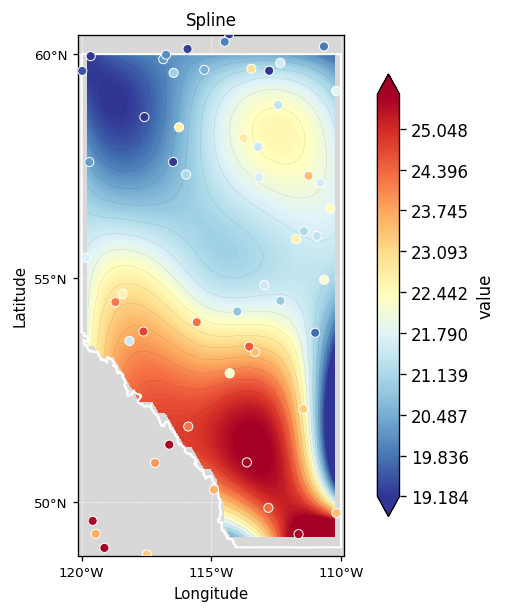
Geostatistical
Machine Learning
Full method reference with all 18 canonical methods